
Great Migration Safari Guide: Seasons, Regions and Viewing Plans
The Great Migration describes large-scale movements of wildebeest and other grazing animals across the Serengeti-Mara ecosystem. UNESCO describes it as an extraordinary natural process associated with the Serengeti's protected.
AR Team
Contributor

The short answer
The Great Migration is a moving wildlife process across the Serengeti–Mara ecosystem, not a guaranteed river-crossing show on a fixed date. Conditions influence where herds graze and travel. Plan around regions, camp locations and time available, and treat monthly migration calendars as approximate tendencies rather than forecasts of an individual herd's movements.
On this page
The Great Migration is a clockwise loop of wildebeest, zebras, and gazelles that follows rainfall and fresh grass across the Serengeti in Tanzania and the Masai Mara in Kenya. The herds are never in one place for long, which means the best experience depends on choosing the right month and the right location.
The herd's yearly cycle

The migration is broadly seasonal, but its exact timing shifts from year to year with rainfall. In general, the herds calve on the short-grass plains of the southern Serengeti in the early part of the year, move north and west through the middle of the year, and cross the Mara River into Kenya in the second half. Wildlife guides track the herds daily, so it is worth confirming the latest position before you book.
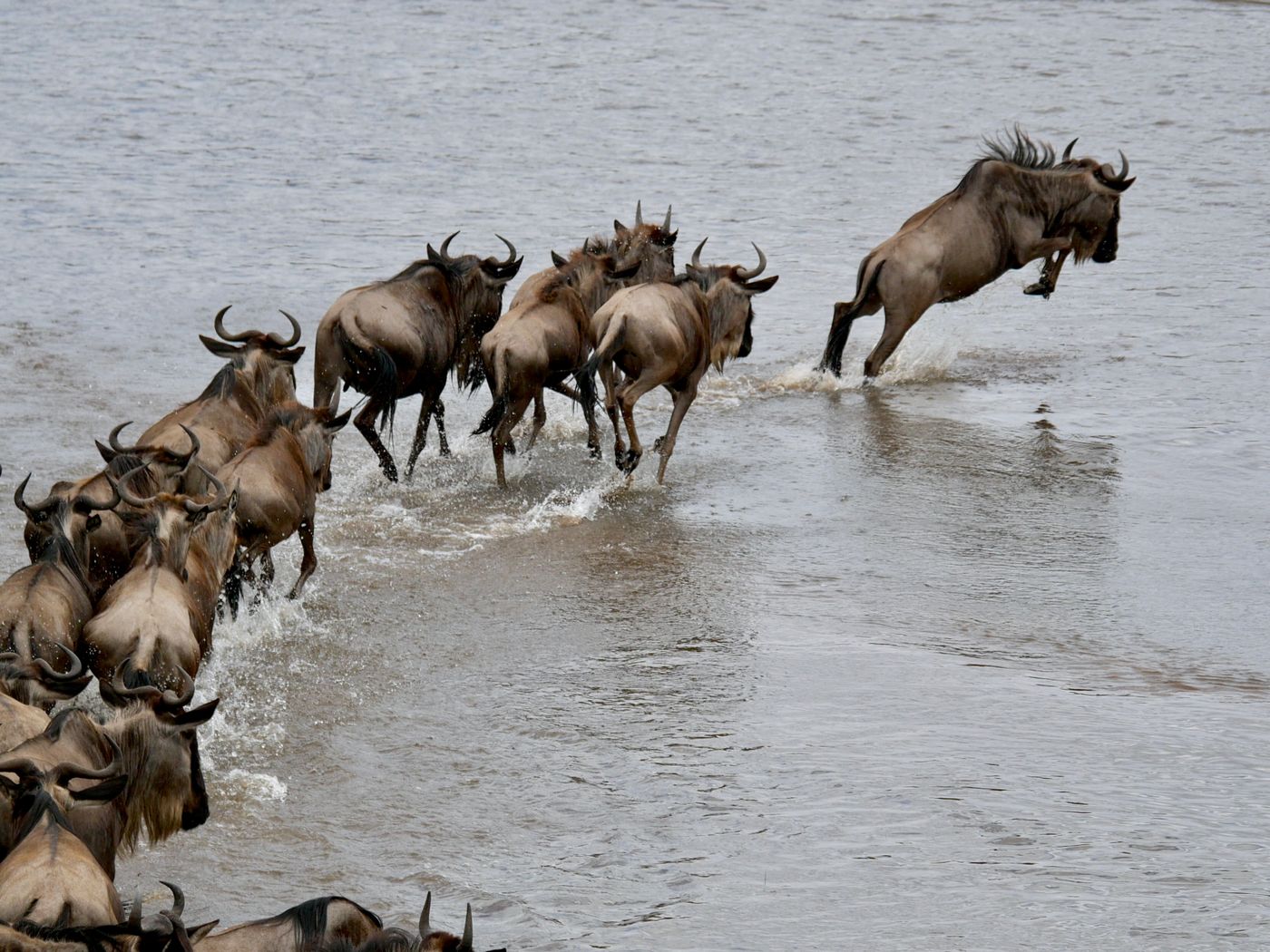
Best months for each part of the migration
- January to March: calving season on the southern Serengeti plains, around the Ndutu and Ngorongoro area. Predators, including lions and cheetahs, are active nearby.
- April to June: the herds gather and move north. Roads can be wet, so check access before you plan.
- July to October: the herds reach the western and northern Serengeti and the Masai Mara. Mara River crossings are the most famous spectacle in this period.
- November to December: the herds begin moving back south as the short rains arrive. Viewing is quieter and lodging is often cheaper.
Best viewing spots, ranked
1. Mara River, Masai Mara (Kenya). The river crossings here are the classic image of the migration. Crossings are unpredictable, and herds may wait on the banks for days, so plan for flexibility.
2. Grumeti River, western Serengeti (Tanzania). Crossings happen here earlier than on the Mara, and the surrounding woodland often produces dramatic predator sightings as well.
3. Ndutu and the southern Serengeti (Tanzania). Best for calving season. The short grass makes the herds easy to see, and the density of predators is high.
4. Seronera, central Serengeti (Tanzania). A reliable base for year-round game drives, with the herds passing through at various times of year.
Practical tips
- Book lodging early for July to October, when demand is highest.
- Allow a minimum of four days to improve your odds of seeing a crossing.
- Ask your guide about the latest herd position before each drive.
- Compare Serengeti and Masai Mara permit costs, since they differ and change.
Most visitors who see the migration describe it as a combination of patience and luck. Choosing a guide with current knowledge of herd movements improves the odds more than any other single decision.
What the Great Migration really is
The Great Migration describes large-scale movements of wildebeest and other grazing animals across the Serengeti-Mara ecosystem. UNESCO describes it as an extraordinary natural process associated with the Serengeti's protected landscapes. It is not a single annual event with a start bell, fixed finish line and guaranteed river crossing. Animals move in response to grazing, water, weather and changing conditions on the ground. Travellers booking a 'migration safari' should ask which stage and which geographic area the trip is designed to observe. A safari can be excellent even when large herds are outside the planned route.
Southern Serengeti and calving landscapes
The southern Serengeti and adjoining short-grass plains around the Ngorongoro Conservation Area are associated with an important phase of the migratory cycle. UNESCO notes the links between the Ngorongoro and Serengeti systems. Travellers interested in young animals and predator behaviour may find these grassland settings especially compelling, but the specific timing and distribution of herds vary. A package advertising a precise calving spectacle months in advance should be treated as an estimate. Consider access roads, accommodation locations and the distance from camp to the likely viewing area. One extra day can be more valuable than changing camps repeatedly.
Central and western movement
As conditions change, herds can be dispersed across central or western portions of the Serengeti ecosystem. This is why broad seasonal maps should be used as orientation rather than navigation instructions for a fixed booking. Different wildlife species and resident predators remain interesting even when the main movement is elsewhere. Ask local guides what conditions have been like in recent weeks and how far drives typically go. An experienced operator should explain uncertainty rather than promising a dramatic crossing every afternoon. Roads and access can also be affected by rain, which changes the practical itinerary regardless of a published calendar.
Northern Serengeti and the Mara River
River crossings attract attention because of their scale and drama, but they are unpredictable. A herd may gather, turn back, wait or cross at a location that is not accessible to visitors. It is not ethical to pressure animals or crowd crossing points for photographs. Drivers should respect restrictions designed to manage vehicle congestion and wildlife disturbance. Some travellers spend several days in the wider area without witnessing a crossing, yet still enjoy substantial wildlife viewing. If a river-crossing opportunity is central to your trip, budget enough time and choose an operator honest about the uncertainty and about which roads or viewing sites are authorised.
Masai Mara: part of a cross-border ecosystem
The Kenyan Mara and Tanzania's Serengeti form a connected landscape, not separate migration machines. Whether sizeable herds are in a particular part of the Mara depends on conditions and the movement's progression. A visit outside a commonly advertised peak period can still offer wildlife viewing, but it should not be sold as guaranteed migration exposure. Confirm whether accommodation is within or outside the reserve or a conservancy, and understand the different access rules. Travel from Nairobi, camp transfers and the time spent reaching game-drive areas can make a large difference to the number of useful viewing sessions.
Choosing where to sleep
Camp position is one of the most important but least understood parts of a migration itinerary. Two properties marketed under the same regional name may be separated by hours of driving, especially when road conditions are poor. Check whether the itinerary uses seasonal camps, permanent lodges or vehicle transfers between locations. Ask exactly where the morning drives begin, whether the camp moves during your stay and what happens if the animals are elsewhere. Avoid paying a premium for a supposed guaranteed crossing location. A camp with knowledgeable guides and flexible routes is often a more resilient choice than a promise tied to a calendar date.
How many days to allow
A brief visit may provide spectacular sightings, but it increases the risk that a highly specific wildlife goal will not materialise. Allow time for multiple drives and weather-related changes where possible. If you have limited days, select one sensible region rather than racing across the Serengeti-Mara landscape. Transfers between Tanzania and Kenya also require attention to borders, travel documentation and itinerary design. Do not assume that a border crossing can be made conveniently from every camp. A tour that offers both countries in a few days may devote more hours to travel than game viewing.
Other wildlife worth watching
The ecosystem contains a great deal more than migrating wildebeest. Predators, birds, resident herbivores and seasonal changes in vegetation all contribute to the encounter. Learning to notice behaviour—grazing, alertness, predator movement and interaction with the environment—can be more rewarding than ticking off one cinematic river crossing. Guides should explain the limits of what they know rather than create a story around every animal movement. A quiet hour observing a resident species may reveal more about the habitat than rushing from one reported herd to another.
Costs, conduct and conservation
Migration-focused itineraries may cost more at times of strong demand, but prices differ by accommodation, concession, transport, guiding and included park fees. Compare the total package and cancellation conditions. Ethical travel matters especially around concentrated wildlife events: do not encourage drivers to block animals, drive off approved tracks or crowd sensitive locations. Migration corridors depend on landscape connectivity, conservation decisions and local communities. Treat the rules of each park or conservancy as essential, not obstacles to photography. Check official notices shortly before departure because access, weather and fee policies can change.
The most honest migration calendar
Think of the year as a series of tendencies, not appointments. Movement through southern, central, western and northern parts of the ecosystem is influenced by rainfall and available forage. Broad monthly guides may help identify the type of experience a traveller hopes for, but should always be accompanied by a warning about variability. Before booking, ask a knowledgeable operator what region is being targeted and what alternative game viewing exists if herds take a different route. Reconfirm your logistics and guiding plans closer to departure. No published chart can tell you exactly when a wild herd will cross a river.
Official and conservation sources
SANParks — wildlife visitor conduct
Kenya Wildlife Service — park information
Frequently asked questions
When is the best time to see the Great Migration?
July to October is the most popular window, when herds cross the Mara River into Kenya. January to March is best for calving season on the southern Serengeti plains. The exact timing varies from year to year.
Where do the wildebeest cross rivers?
The most famous crossings are on the Mara River in the Masai Mara, Kenya. Crossings also occur on the Grumeti River in the western Serengeti, Tanzania, usually earlier in the year.
Can you see the migration without a guide?
Self-drive visitors can see the herds in Kenya and Tanzania, but guides track daily movements and know where crossings are likely to occur. A guided drive significantly increases your chances of a good sighting.
When will the wildebeest cross the Mara River?
There is no guaranteed crossing date. Herd decisions depend on conditions and may change repeatedly.
Should I book Tanzania or Kenya for the migration?
Choose according to the region and phase you hope to see, your dates, transfer logistics and available time rather than assuming one country is always better.
Key facts
Select a fact to read its supporting reference.
-
Verified
-
Verified
-
Verified
-
Verified
Methodology and limits
Seasonal ecological interpretation rather than fixed predictions; no guaranteed dates or precise crossing locations.
Research references and access dates
The linked key facts above point directly to their supporting references. The full research register is available for checking.
- UNESCO — Serengeti migration UNESCO · Accessed 2026-11-02
- UNESCO — Ngorongoro ecosystem UNESCO · Accessed 2026-11-02
- SANParks — wildlife visitor conduct SANParks · Accessed 2026-11-02
- Kenya Wildlife Service — park information Kenya Wildlife Service · Accessed 2026-11-02
- Mara Conservancies Association — migration corridors Mara Conservancies Association · Accessed 2026-11-02
- Mara Conservancies Association — 2026 conservation strategy Mara Conservancies Association · Accessed 2026-11-02
Last verified 2026-11-01 · Reviewed by AR Team
Explore more Wildlife & Safaris